

A Short History of the NAUA
March 2026
Introduction
Modern Unitarianism grew, since enlightenment times, from its Christian, Anabaptist roots. Like many protestant Churches, schisms have developed as understanding, science and social movements provide need and opportunity for change and rebirth. This brief history recounts that journey for North American Unitarians. As JR Tolkien noted “Not all those who wander are lost.”
Mission
The North American Unitarian Association was born in 2022 with a mission to defend, promote and nourish the traditional Unitarian principles of freedom reason, and tolerance. These values were first articulated by Unitarian Minister and historian Dr. Earl Morse Wilbur in A History of Unitarians (1945).
A statement declaring the “inherent worth and dignity of every person” was added to create a framework of beliefs for the original NAUA society. The mission of NAUA was to provide a support and education network for individuals and congregations focused on traditional Unitarian principles and non-creedal – theological diversity.
Reaction to Post-Modernism
The NAUA was conceived much earlier than 2022. It was formed first in the minds and hearts of Unitarians who witnessed the displacement of liberal ideas, ideals and practices by an emergent post-modern theology and ideology.
Post modernism is a late twentieth century social and philosophical movement that emphasizes:
- relativism and subjectivity,
- pluralism that embraces multiple and often contradictory viewpoints rather than any objective truth,
- an ironic and often cynical view of both history and modern ideas and culture
- a focus on the overarching influence of power in social, economic and political interactions.
During the early decades of the 21st century post-modern philosophy came to dominate thinking and leadership in many liberal institutions including universities, justice institutions, journalism, health, medicine and formerly liberal religions.
Within mainline Unitarian Universalist organizations, post-modern ideals gave rise to a new type of ideological thinking coupled with new types of social justice activism. Traditional support for “free and responsible search for truth” was supplanted by an expansion of the idea of “harm” to include emotional harm, engendering feelings of isolation, lack of affirmation and other verbal and non-violent behaviours that were deemed to be “out of covenant”.
Unitarians also have a long history of social activism forming abolition, civil rights and more recently gay and lesbian rights recognition groups. Unlike earlier social justice efforts, post-modern thinking, with a focuse on power, determined that those belonging to more economically and politically powerful identity groups were to be held responsible for the sins and transgressions of their identity group. Thus, males, those identified as white, the heterosexual and hetero-normative individuals were called to “do the work” and become allies of those identity groups perceived to hold less overt power. This was justified by “a belief that having a marginalised identity brings with it both knowledge and the right to speak on issues of social justice” (Helen Pluckrose, Cynical Theories)
This focus on identity group membership as opposed to individual identity and responsibility, created social divisions and tensions that are contrary to a focus on the inherent worth and value of every person. In addition, the function of Unitarian social justice efforts changed from a focus on structural change and reformation of laws and practices with a focus on outward and often performative display of support and solidarity with existing and emergent social identity groups. To paraphrase George Orwell the established Unitarian Universalist denomination argued that “All persons are equal, but some persons are more equal than other persons”.
Post-modern thinking also nourishes a culture of conformity and universality that resulted in many censoring their own thoughts, not wishing to cause “harm” to others. This is antithetical to the traditional Unitarian focus on individual freedom and expression. Open communications is perceived as a threat to group solidarity and to identity groups that were perceived as less powerful or traditionally marginalized.
Persecution of Unitarian Dissidents
This period was marked by publications of books, documentaries and articles, criticizing and challenging not only the Unitarian denomination but other social institutions that had come under the influence of related post-modern ideals. Within the Unitarian Universalist denomination, a campaign and culture to censure these dissenting views also developed.

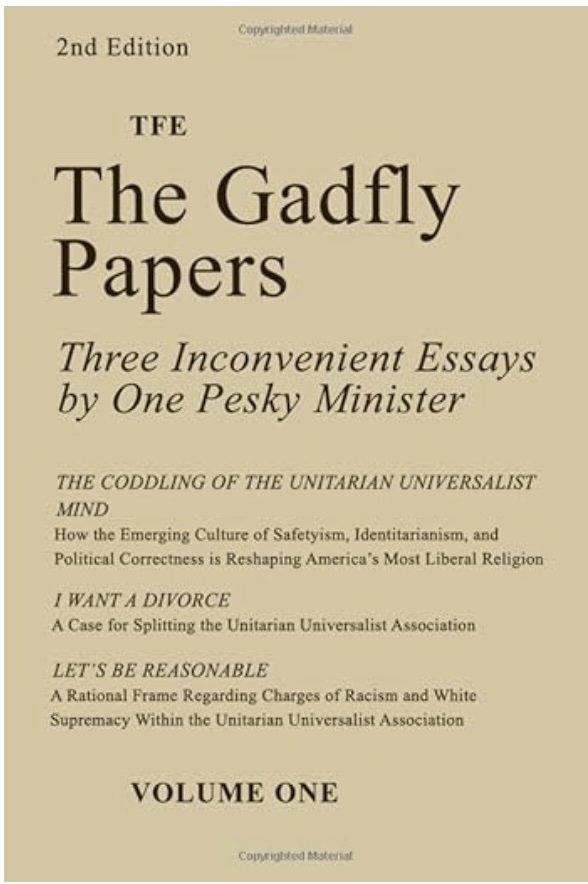
This censorship was highlighted by the denominational leadership reaction to the publication and free distribution of the Gadfly Papers – Three essays by One Pesky Minister by Todd Eklof in 2019.
This publication became a flash point when over 500 Unitarian ministers publicly dismissed and criticized the author- many without having read the work. In addition, none of the critics identified the supposed errors and hatefulness claimed, nor would they engage in open discussion of the claims made in the text.
Within less than a year Rev. Eklof was disfellowshipped from the Unitarian Universalist Minsters’ Association and denominational efforts were made to destabilize his congregation in Spokane Washington (Eklof, The Gadfly Affair, 2021). These actions were perceived by many Unitarians as a suppression of free and dissident thinking. Subsequent efforts by Eklof and other authors to make leadership change within the UUA were not successful. Through bylaw changes, nomination process manipulation and orchestrated campaigns by professional leadership, efforts were made to discredit Eklof and others dismissively designated as ‘Gadflies’.
Initial NAUA Organization and Activities
The creation of the NAUA was first announced during a sermon by Rev. Eklof at the Unitarian Universal Church of Spokane on Dec. 4, 2022. One online participant commented in the chat “I feel like I just witnessed the nailing of the 95 theses by Martin Luther in 1517 on the door of the church in Wittenberg, Germany”
In 2022, Rev. Eklof founded the NAUA. It was designed as a support service for Unitarians, Universalists and other religious individuals and organizations. A steering group of eight individuals – each with history of Unitarian leadership was selected by Rev Eklof. Most of these initial leaders were either local or online members of the Unitarian Universalist Church of Spokane.
The first order of business for the new organization was the creation an online presence to recruit, educate and support interactions among Unitarians, Universalists and liberal supporters. The NAUA website NAUNITARIANS.ORG went online in January 2023, at the same time the NAUA was incorporated in the State of Washington, USA. Postal mail was funneled through the Spokane Church.
To nurture the social, educational and promotional needs of the new organization a variety of groups and structured activities were initiated. These included:
- Publication of a Journal- The Liberal Beacon
- Publication of a periodic newsletter, the Compass
- Regular online educational session known as the NAUA Academy
- Structured online and informal drop-in Circles
- Monthly online worship services
- A variety of Ministers’ support services
- An International Alliance of supporters from outside North America
- Yearly Summit meeting featuring keynote speakers, interest sessions and the annual business meeting.
- Video recordings of most of these activities are archived on the NAUA website for free use by Unitarian organizations and other groups.
The first Summit meeting took place in Spokane and simultaneously online in October 2024 at which time formal bylaws of the association were adopted and a board of directors, led by Rev. Eklof was formally elected. In early 2025 Joanne Krettek was hired as NAUA’s part time staff member to support communications and other committee activities.
The NAUA was granted membership in the International Association for Religious Freedom in 2025 and began sharing programming with this large international organization.
New board members were elected during the 2nd Summit, held online in October 2025.
Resignation of Founder
Later in 2025, a personality dispute arose between board president Rev. Dr. Todd Eklof and one of the board members. This dispute led to the resignation of Rev. Eklof and after some delay, to two other board members. These members were replaced, and the new board began expanding programming and developing new ways to support member communications and strengthen NAUA organizational infrastructure.
Current NAUA
The NAUA continues to grow in both individual and congregational numbers -providing an ongoing voice and community for those attracted to liberal ideas of freedom, reason and tolerance. In addition, a task force is at work to articulate and promote a set of guiding principles for individual and organizational application.
The NAUA remains committed to championing noncreedal religious thinking and organization, celebrating individual difference of opinion and welcoming free debate and discussion. It also continues to work to educate and promote individual and organization efforts at creating and sustaining a more just and caring society.